If you’re building a headless eCommerce store with OrderCloud, understanding how key objects like catalogs, categories, and products are structured is essential for scaling in an organized and flexible way.
OrderCloud is an API-first eCommerce platform built around well-defined entities. These are the main ones:
| Entity | Details |
|---|---|
| Marketplace | The general environment where you configure your store (can include sellers and buyers). |
| Buyer | Represents a customer or group of customers. |
| User | Users within a buyer. |
| Catalog | Collection of grouped products, associated with buyers. |
| Product | Individual item being sold. |
| Category | Hierarchical organization within a catalog (e.g., Purses, Bags, Totes). |
| Variant | Product variations (e.g., color, size). |
| PriceSchedule | Defines prices, valid dates, minimum quantities, etc. |
| Inventory | Stock management per product or variant. |
| Order | User’s order. |
¿What are Catalogs?
In OrderCloud, a Catalog represents a logical collection of products. You can create multiple catalogs based on customer type (retail vs. wholesale), season, or geographic location.
Within the OrderCloud portal, you can create all these entities easily. Select the entity from the left panel, and on the right panel, you’ll find all the available endpoints. You can start using them right away by simply clicking Send. Of course, everything will be empty at first.
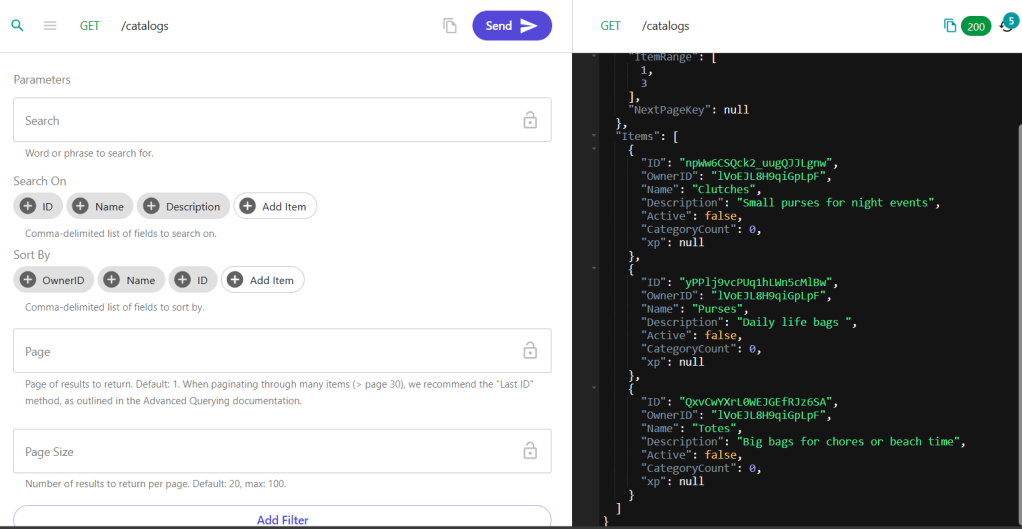
Once you’ve used the CREATE method, you’ll be able to see what you’ve added using GET List.
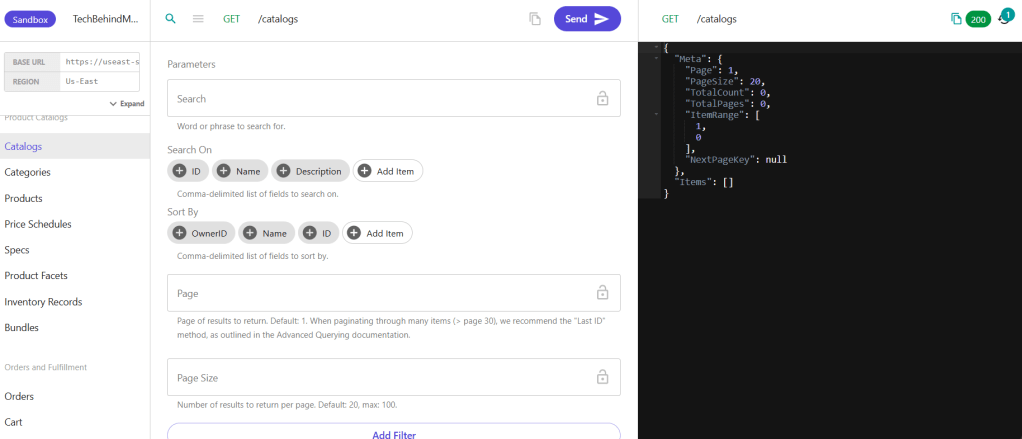
Of course, after experimenting with the CREATE method, we now have examples that we can list using the GET List method.
POST /catalogs
{
  "ID": "FASHION2025",
  "Name": "Spring Fashion Catalog 2025"
}
¿What are Categories?
Categories are hierarchies within a catalog. They don’t directly hold products but are used to organize and navigate the catalog (e.g., «Handbags», «Shoes», «Accessories»).
POST /catalogs/FASHION2025/categories
{
  "ID": "PURSES",
  "Name": "Purses",
  "ParentID": null
}TIP: You can nest categories (e.g., Handbags > Leather > New Arrivals).
¿What About Products?
Products are the sellable entities. They can be assigned to multiple catalogs and categories. They support variants (like color or size) and extended properties (XP).
POST /products
{
  "ID": "PURSE-BLACK-01",
  "Name": "Black Purse",
  "Active": true,
  "Description": "Handmade purse",
  "PriceSchedule": {
    "ID": "BASE-PRICE-2025"
  },
  "xp": {
    "Material": "Fabric",
    "Color": "Black"
  }
}
Then, assign the product to the catalog and category:
POST /catalogs/FASHION2025/products/PURSE-BLACK-01
POST /categories/CARTERAS/products/PURSE-BLACK-01
Why Is This Hierarchy Important?
- Scalability: You can have a separate catalog per country, event, or channel without duplicating products.
- UX Flexibility: By separating categories from products, you control navigation without affecting inventory.
- Personalization: With XP and multiple catalogs, you can offer tailored experiences to different types of customers.
Understanding the entity structure in Sitecore OrderCloud is essential to building a solid, scalable store. As we move forward, we’ll dive deeper into configuring products, variants, dynamic catalogs, and personalized customer experiences.
Don’t miss the upcoming tutorials where I’ll guide you step by step in launching your professional and efficient eCommerce store.
 Tech behind Marketing